

Introduction
2 Thessalonians appears to have been written shortly after 1 Thessalonians. They are still being persecuted (Ch. 1), and they are still thinking about Jesus’ return and are afraid that he has already come, but that they missed it (Ch. 2).
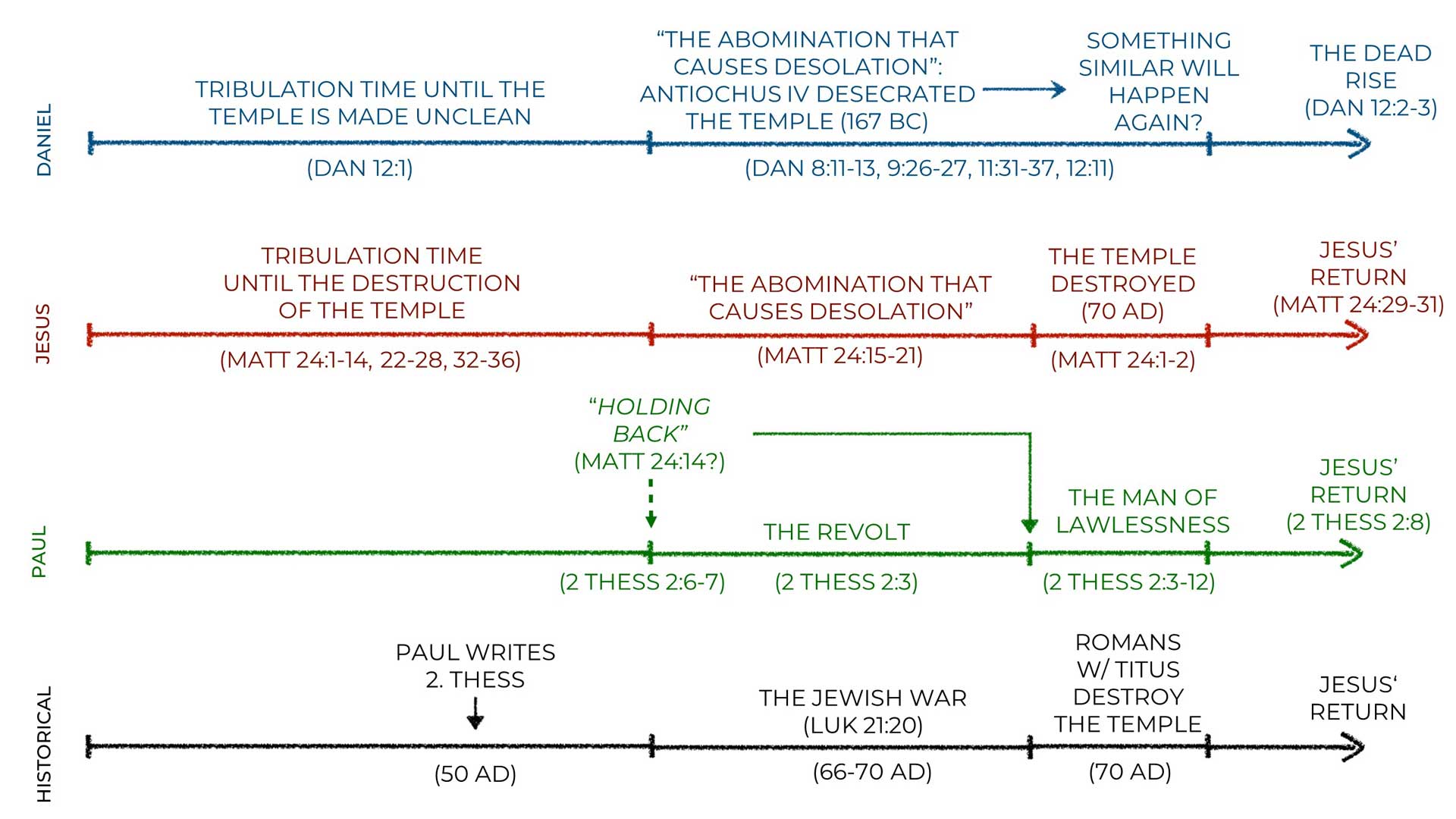
It is possible that this confusion and fright came from someone having sent a false letter in Paul’s name (2:2, 3:17). Paul explains to them that they don’t need to be afraid that this has already happened because first, the rebellion must occur, and the man of lawlessness will be revealed (2:3). We might wish that he explained more about this, but the point is in any case that no one should have to wonder whether Jesus has returned or not.
In chapter 3 he warns against laziness and idleness. They will continue with a normal life until Jesus returns.
Structure
Ch. 1 Their endurance in persecutions (Opening)
Ch. 2 Jesus’ return has not happened
Ch. 3 Warnings against laziness
Background
- Written around year 50, shortly after 1 Thess.
- They are still persecuted (1:4-7)
- They wondered if Jesus’ return had already happened. Possibly because of a false Pauline letter (2:2, 3:17).
- Some do not follow Paul’s example and his teachings about how they should live, and they are going astray (3:6-15)
Themes in the opening (Ch. 1)
- They show perseverance and faith in persecution (vv. 3-4, 11) à 2:13-17, 3:2-3
- God’s righteous judgment (vv. 5-7) à 2:12
- Jesus’ return (vv. 8-10) à 2:1-12
- A lifestyle worthy of their calling (vv. 11-12) à 3:6-15
1:8 – “those who do not know God” AND “those who do not obey the gospel of our Lord Jesus”?
A. Sounds like two groups (most translations)
Most literal translation since the definite article is repeated (“those who”)
➡ All who do not know God will be judged, not only those who know about him but who are still disobedient.
B. Sounds like one group (NIV)
Parallelism like in Jer 10:25: “Pour out your wrath on the nations that do not acknowledge you, on the peoples who do not call on your name.”
Is it possible to know God but still disobey the gospel? In the Bible, “knowing God” means more than knowing about him (e.g., John 17:3).
Destruction (1:9)
In verse 9, “everlasting destruction” is defined as an eternity “shut out from the presence of the Lord and from the glory of his might”. Does this mean eternal torment or annihilation? The same word for “destruction” is used in:
- 1 Thess 5:3: “While people are saying, “Peace and safety,” destruction will come on them suddenly, as labor pains on a pregnant woman, and they will not escape.”
- 1 Tim 6:9: “Those who want to get rich fall into temptation and a trap and into many foolish and harmful desires that plunge people into ruin and destruction.”
- 1 Cor 5:5: “hand this man over to Satan for the destruction of the flesh, so that his spirit may be saved on the day of the Lord.”
Before the Second Coming (2:3-4)
This is some of the “basic training” that he had given them when he was with them (vv. 5-6):
1. The apostasy/rebellion must come
- Matthew 24:10-13 speaks of both apostasy and rebellion. Most likely Paul gets it from Jesus since it is known and general. (Also 2 Tim 3:1-9)
- The parallel in Mark 13:22 mentions false teachers who will lead astray (1 Tim 4:1-3, 2 Tim 4:3-4)
- Rebellion against God or a worldly rebellion?
2. The man of lawlessness must be revealed
- Maybe the same figure as the Antichrist, although the name is not used.
Antichrist candidates
Emperor Nero, Emperor Titus, Muhammad, Vandal Genseric, Frederick Barbarossa, Pope Paul VI, Pope John XII, The Papacy, Luther (666), Napoleon, Hitler, Mussolini, Stalin, John F. Kennedy, Jimmy Carter, Ronald Reagan, Gorbachev, Henry Kissinger, Pope John Paul II, Kurt Waldheim, Willy Brandt, Prince Bernard, Moammar Gaddafi, Karl Von Hapsburg, Pat Robertson, King Juan Carlos of Spain, Anwar Sadat, Obama, Trump, etc.
What is holding him back and who is the one who holds it back (2:6-7)
1. The principle of law and order (Bonhoeffer et al.)?
- “He” is the emperor, who personified law and order for Paul
- Rom 13: The authorities have their power from God
2. The mission (Calvin)?
- “He” is Michael, another angel, or Paul.
3. The emperor preceding an emperor who made himself a god (Nero)?
- The name Claudius is linked to a Latin word for “to hold back”
4. The Holy Spirit?
- Can be called both he and it, but should he be “taken out of the way”?
Dan 11:36 about Antiochus IV Epiphanes (175–164):
“The king shall do as he pleases. He will exalt himself and exalt himself above every god, and against the God of gods he will speak terrible words. He shall prosper until the wrath is finished.”
The lawless one (2:3-9)
1. Paul continues to build on Jesus’ words in Matthew 24 (par. Mark 13 / Luke 21)
A. The Rebellion is the Jewish War (66-70) and the Lawless One is General Titus who defiled the Temple and destroyed it in AD 70.
Jesus speaks of the “abomination of desolation” in the temple and refers to Daniel (Matthew 24:15). Paul also seems to do so when he seems to be thinking of Antiochus IV here. Paul referred to Matt 24 in 1 Thess as well.
Fits with Matt 24, etc., that the end could not come until after the year 70, but not immediately after this. “What is holding him back” (2:7) = the mission of the entire Roman Empire.
Now, this has happened, and Jesus can come as a thief at any time.
Problems:
- The Roman authorities can be seen as taking God’s place, but Titus did not perform signs and wonders and in that case, only “seduced” Romans.
- Sounds like the lawless one lives until Jesus returns.
B. Matt 24 is still in the future – there will be an apostasy/rebellion and the Antichrist will appear.
- The Temple in Jerusalem will be rebuilt.
- It is not the literal temple that is meant, but the congregation.
2. Paul does not build on Matthew 24, but has new information:
Only the Thessalonians knew what he meant and it cannot be vital for us to know exactly what it is, as it is not clearer.
2:10-12
- Who is deceived by the lawless one?
- What is the reason they are deceived?
- Why does God send a delusion?
3:6-15
- General disdain for craftsmanship among the aristocracy of the Roman Empire.
- Had they stopped working because Jesus was returning soon? Did any of them depend on support from others?
- “does not live according to the teaching”: Military term for those who don’t follow orders or don’t behave properly.
Paul and Silas were examples of the opposite lifestyle:
- paid for the food they received
- worked hard day and night not to be a burden
Timeless truth: “Idleness is the root of all evil.” Work is a good thing that God instituted. When we work, we honor and serve God.
What does 2 Thessalonians tell us?
- We are called to live holy lives for God’s glory and joy even in opposition and persecution. What might this look like in your life?
- Don’t be intimidated by end-time speculation and calculations. Jesus’ return is our great and glorious hope (1:5,7,10, 2:1,14,16), not something scary that we should fear. How do we live our lives in light of Jesus’ return?
- Work is a good thing with which we can honor God no matter what our work is. What does this mean for you?